

Can I Wear Makeup When.having Sinus Ct Scan S
CT Sinuses
Computed tomography (CT) of the sinuses uses special x-ray equipment to evaluate the paranasal sinus cavities – hollow, air-filled spaces within the bones of the confront surrounding the nasal cavity. CT scanning is painless, noninvasive and accurate. It'south also the most reliable imaging technique for determining if the sinuses are obstructed and the best imaging modality for sinusitis.
Tell your dr. if there's a possibility you are significant and discuss whatever recent illnesses, medical conditions, medications you're taking, and allergies. This exam does not commonly require contrast fabric; however, in some situations your doctor may asking that contrast material exist given. If you lot accept a known allergy to contrast cloth, your doc may prescribe medications to reduce the risk of an allergic reaction. These medications must exist taken 12 hours prior to your exam. Go out jewelry at home and article of clothing loose, comfortable clothing. You may need to change into a gown for the process.
- What is CT (Computed Tomography) of the Sinuses?
- What are some mutual uses of the process?
- How should I fix?
- What does the equipment look like?
- How does the procedure piece of work?
- How is the process performed?
- What volition I feel during and after the process?
- Who interprets the results and how exercise I get them?
- What are the benefits vs. risks?
- What are the limitations of CT of the Sinuses?
- Which examination, procedure or treatment is best for me?
What is CT (Computed Tomography) of the Sinuses?
Computed tomography, more commonly known as a CT or True cat scan, is a diagnostic medical imaging test. Similar traditional 10-rays, it produces multiple images or pictures of the inside of the body.
A CT scan generates images that can exist reformatted in multiple planes. It can even generate three-dimensional images. Your doctor can review these images on a computer monitor, print them on film or via a 3D printer, or transfer them to a CD or DVD.
CT images of internal organs, basic, soft tissue, and claret vessels provide greater detail than traditional x-rays. This is particularly truthful for soft tissues and claret vessels.
A CT scan of the confront produces images that also show a patient's paranasal sinus cavities. The paranasal sinuses are hollow, air-filled spaces located within the basic of the face up and surrounding the nasal cavity, a system of air channels connecting the nose with the back of the throat. At that place are four pairs of sinuses, each connected to the nasal cavity past small-scale openings.
superlative of folio
What are some common uses of the procedure?
CT of the sinuses is primarily used to:
- help diagnose sinusitis.
- evaluate sinuses that are filled with fluid or thickened sinus membranes.
- detect the presence of inflammatory diseases.
- provide additional information nearly tumors of the nasal crenel and sinuses.
- plan for surgery by defining anatomy.
superlative of page
How should I set?
Habiliment comfy, loose-plumbing equipment article of clothing to your exam. You may need to change into a gown for the procedure.
Metal objects, including jewelry, eyeglasses, dentures, and hairpins, may affect the CT images. Go out them at home or remove them prior to your exam. Some CT exams volition require you to remove hearing aids and removable dental work. Women will need to remove bras containing metallic underwire. You may need to remove whatsoever piercings, if possible.
Your doctor may instruct you to non consume or drink anything for a few hours before your test if information technology will use contrast material. Tell your doctor about all medications you are taking and if y'all accept any allergies. If you lot have a known allergy to contrast material, your doctor may prescribe medications (normally a steroid) to reduce the take chances of an allergic reaction. To avoid unnecessary delays, contact your dr. well earlier the date of your exam.
Also tell your doctor about any recent illnesses or other medical conditions and whether you accept a history of heart disease, asthma, diabetes, kidney disease, or thyroid problems. Any of these atmospheric condition may increment the chance of an adverse outcome.
Women should always inform their physician and the CT technologist if there is any possibility that they may be pregnant. Meet the CT Rubber During Pregnancy page for more information.
summit of page
What does the equipment look like?
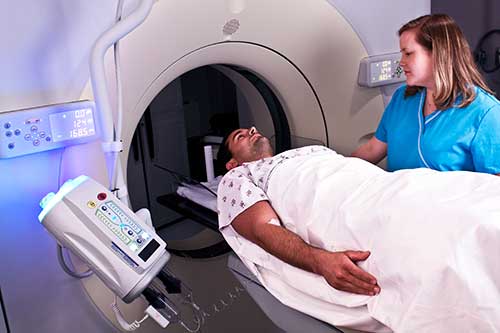
The CT scanner is typically a large, donut-shaped motorcar with a short tunnel in the middle. You will lie on a narrow tabular array that slides in and out of this short tunnel. Rotating effectually you, the x-ray tube and electronic x-ray detectors are located opposite each other in a ring, called a gantry. The computer workstation that processes the imaging information is in a separate control room. This is where the technologist operates the scanner and monitors your examination in directly visual contact. The technologist will be able to hear and talk to you using a speaker and microphone.
elevation of page
How does the procedure work?
In many ways, a CT browse works like other 10-ray exams. Different body parts absorb x-rays in different amounts. This deviation allows the medico to distinguish body parts from i another on an x-ray or CT paradigm.
A conventional x-ray examination directs a small amount of radiation through the body role under examination. A special electronic image recording plate captures the epitome. Bones appear white on the ten-ray. Soft tissue, such every bit the centre or liver, shows upwards in shades of gray. Air appears black.
With CT scanning, several x-ray beams and electronic 10-ray detectors rotate around y'all. These measure the amount of radiation being captivated throughout your body. Sometimes, the test tabular array will move during the browse. A special computer plan processes this large book of data to create 2-dimensional cross-exclusive images of your body. The organization displays the images on a estimator monitor. CT imaging is sometimes compared to looking into a loaf of bread by cutting the loaf into thin slices. When the calculator software reassembles the image slices, the result is a very detailed multidimensional view of the body'due south interior.
Nearly all CT scanners can obtain multiple slices in a single rotation. These multi-slice (multidetector) CT scanners obtain thinner slices in less time. This results in more detail.
Mod CT scanners can image big sections of the body in merely a few seconds, and fifty-fifty faster in small children. Such speed is beneficial for all patients. Speed is especially beneficial for children, the elderly, and critically sick – anyone who finds it difficult to stay nonetheless, fifty-fifty for the brief time necessary to obtain images.
For children, the radiologist will adjust the CT scanner technique to their size and the area of interest to reduce the radiations dose.
Some CT exams use a contrast material to enhance visibility in the body area under examination.
top of folio
How is the procedure performed?
The technologist begins by positioning patients on the CT examination table.
For a CT scan of the sinuses, the patient is most commonly positioned lying flat on the back. The patient may also be positioned face-down with the chin elevated.
Straps and pillows may be used to assist the patient maintain the correct position and to agree still during the exam.
Some patients require an injection of a contrast material to enhance the visibility of certain tissues or claret vessels. If contrast textile is required, a nurse or technologist will insert an intravenous (Four) line into a small vein in the patient's mitt or arm. The contrast fabric will be injected through this line.
Adjacent, the table volition motion apace through the scanner to determine the correct starting position for the scans. So, the tabular array will motility slowly through the machine for the actual CT scan. Depending on the type of CT scan, the machine may make several passes.
The technologist may ask you lot to agree your breath during the scanning. Whatever motion, including animate and trunk movements, can lead to artifacts on the images. This loss of image quality tin resemble the blurring seen on a photograph taken of a moving object.
When the exam is consummate, the technologist will ask you to wait until they verify that the images are of loftier enough quality for accurate interpretation past the radiologist.
The bodily CT scan takes less than a minute and the entire process is usually completed within 10 minutes.
top of page
What volition I experience during and later on the procedure?
CT exams are mostly painless, fast, and easy. Multidetector CT reduces the amount of time that the patient needs to lie still.
Though the scanning itself causes no pain, at that place may be some discomfort from having to remain still for several minutes. If you have a difficult time staying still, are claustrophobic, or have chronic pain, you lot may find a CT exam to be stressful. The technologist or nurse, nether the management of a physician, may offer you some medication to help you tolerate the CT scanning process.
If the exam uses iodinated contrast material, your doc will screen you for chronic or acute kidney illness. The md may administrate contrast material intravenously (by vein), and then yous will experience a pin prick when the nurse inserts the needle into your vein. You may experience warm or flushed equally the contrast is injected. Yous as well may have a metallic taste in your mouth. This will pass. You may feel a need to urinate. However, these are only side furnishings of the contrast injection, and they subside quickly.
When you enter the CT scanner, you may see special light lines projected onto your body. These lines assistance ensure that yous are in the correct position on the test tabular array. With modernistic CT scanners, you may hear slight buzzing, clicking and whirring sounds. These occur as the CT scanner's internal parts, not usually visible to yous, revolve around yous during the imaging process.
You lot will be alone in the exam room during the CT browse, unless there are special circumstances. For example, sometimes a parent wearing a lead shield may stay in the room with their child. However, the technologist volition ever be able to run into, hear and speak with you through a congenital-in intercom system.
With pediatric patients, a parent may be immune in the room but may demand to vesture a pb apron to minimize radiation exposure.
Later a CT exam, the technologist will remove your intravenous line. They will comprehend the tiny hole made by the needle with a small-scale dressing. You tin render to your normal activities immediately.
pinnacle of folio
Who interprets the results and how practise I get them?
A radiologist, a md specially trained to supervise and interpret radiology exams, will analyze the images. The radiologist will ship an official report to the doctor who ordered the examination.
You may need a follow-up exam. If so, your physician will explain why. Sometimes a follow-upwards exam farther evaluates a potential issue with more than views or a special imaging technique. Information technology may also come across if in that location has been whatever change in an issue over time. Follow-up exams are frequently the best way to come across if treatment is working or if a problem needs attending.
tiptop of folio
What are the benefits vs. risks?
Benefits
- CT scan is one of the safest means of studying the sinuses.
- CT is the most reliable imaging technique for determining if the sinuses are obstructed. Information technology is the best imaging modality for sinusitis.
- CT of the sinuses tin assistance plan the safest and most effective surgery.
- CT of the sinuses is now widely available and is performed in a relatively brusque fourth dimension, especially when compared to magnetic resonance imaging (MRI).
- CT scanning is painless, noninvasive, and authentic.
- A major advantage of CT is its ability to prototype bone, soft tissue, and blood vessels all at the aforementioned time.
- Unlike conventional x-rays, CT scanning provides very detailed images of many types of tissue as well equally the lungs, bones, and blood vessels.
- CT exams are fast and simple. In emergency cases, they tin can reveal internal injuries and bleeding quickly plenty to help save lives.
- CT has been shown to be a cost-effective imaging tool for a wide range of clinical problems.
- CT is less sensitive to patient motility than MRI.
- Dissimilar MRI, an implanted medical device of any kind volition not prevent you from having a CT scan.
- CT imaging provides real-fourth dimension imaging, making it a skillful tool for guiding needle biopsies and needle aspirations. This is particularly true of procedures involving the lungs, belly, pelvis, and bones.
- A diagnosis via CT browse may eliminate the need for exploratory surgery and surgical biopsy.
- No radiation remains in a patient's body later a CT exam.
- The x-rays used for CT scanning should take no immediate side effects.
Risks
- There is ever a slight gamble of cancer from excessive exposure to radiations. However, the benefit of an accurate diagnosis far outweighs the risk involved with CT scanning.
- The radiations dose for this process varies. Run across the Radiation Dose in X-Ray and CT Exams folio for more information nigh radiations dose.
- Women should always tell their md and ten-ray or CT technologist if at that place is any chance they are pregnant. Run across the Prophylactic in X-ray, Interventional Radiology and Nuclear Medicine Procedures folio for more than information about pregnancy and 10-rays.
- Doctors do not generally recommend CT scanning for pregnant women unless medically necessary because of potential risk to the unborn baby.
- 4 contrast manufacturers indicate mothers should not breastfeed their babies for 24-48 hours after contrast fabric is given. However, the most recent American College of Radiology (ACR) Transmission on Contrast Media reports that studies show the corporeality of contrast absorbed by the infant during breastfeeding is extremely low. For further information delight consult the ACR Manual on Contrast Media and its references.
- The risk of serious allergic reaction to contrast materials that contain iodine is extremely rare, and radiology departments are well-equipped to bargain with them.
- Because children are more sensitive to radiations, they should accept a CT exam just if it is essential for making a diagnosis. They should not have repeated CT exams unless necessary. CT scans in children should always be done with depression-dose technique.
meridian of folio
What are the limitations of CT of the Sinuses?
CT is usually the first examination ordered when a sinus tumor is suspected. If additional information is needed to determine the extent of soft tissue of the tumor, magnetic resonance imaging (MRI) may be helpful.
A person who is very large may not fit into the opening of a conventional CT scanner. Or, they may be over the weight limit—commonly 450 pounds—for the moving table.
top of page
top of page
This folio was reviewed on June, 15, 2020
Images
Pediatric Content
Some imaging tests and treatments accept special pediatric considerations. The teddy bear denotes child-specific content.
- RadInfo four Kids
Sponsored By


Delight note
RadiologyInfo.org is not a medical facility. Please contact your physician with specific medical questions or for a referral to a radiologist or other physician. To locate a medical imaging or radiation oncology provider in your community, yous can search the ACR-accredited facilities database.
This website does not provide price data. The costs for specific medical imaging tests, treatments and procedures may vary by geographic region. Talk over the fees associated with your prescribed procedure with your doctor, the medical facility staff and/or your insurance provider to get a better agreement of the possible charges you volition incur.
Web page review procedure: This Web folio is reviewed regularly by a physician with expertise in the medical surface area presented and is further reviewed by committees from the Radiological Society of North America (RSNA) and the American Higher of Radiology (ACR), comprising physicians with expertise in several radiologic areas.
Outside links: For the convenience of our users, RadiologyInfo.org provides links to relevant websites. RadiologyInfo.org, RSNA and ACR are not responsible for the content contained on the web pages found at these links.
Source: https://www.radiologyinfo.org/en/info/sinusct
Posted by: lopezunpleted.blogspot.com
0 Response to "Can I Wear Makeup When.having Sinus Ct Scan S"
Post a Comment